March 14: The Origins of the Cold War
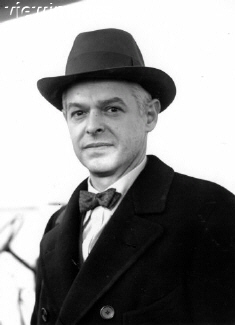
Paul Nitze, author of NSC 68
In 1947, the journalist and
commentator Walter
Lippmann penned an article describing the developing US-USSR confrontation as a "Cold War."
The term came to describe the state of superpower relations for the next four
decades. This class, and the one next week, focuses on the foreign policy aspects of
how the Cold War was waged. In doing so, it raises three questions:
We will answer the first of these questions this week, and focus on the next two in subsequent classes. For reading, beyond the documents below, look at the first two chapters of the Gaddis book. |
| Making the Transition: |
| Historians debate an appropriate starting point for the onset of the Cold War, annd this debate, in many ways, provides an opening for any study of the Cold War. Authors such as David Foglesong and William Appleman Williams trace the beginning to the US intervention in the Russian civil war; still others point to the domestic anti-radicalism of the first Red Scare and the 1920s. Those who pin the start to the post-World War II period divide largely into three camps. Mew Left historians, such as Walter LaFeber but most outspokenly Bruce Cumings of the University of Chicago, see US policies as primarily responsible for the onset of tensions. They argue that the US acted in such a way that created fears of encirclement by the Soviet Union, and the Soviets responded defensively by consolidating their position in Eastern Europe. This viewpoint has been most passionately challenged by Yale University historian John Lewis Gaddis, who sees Soviet actions in general and the decisions of Josef Stalin in particular as the driving force behind the postwar tensions. In recent years, Gaddis has pointed to a large batch of Eastern bloc documents that bolster his view. Taking a position somewhere in the middle, UVA historian Melvyn Leffler has argued in two recent books that the war resulted mostly from a combination of the domestic institutional situations in both nations and balance-of-power forces, in which both the US and USSR were drawn into a power vacuum in central Europe. |
Background:
The end of World War II saw two major powers dominating the European scene: the United States, whose troops liberated the western half of the continent; and the Soviet Union, whose Red Army had driven the Germans from eastern and east-central Europe. Europe thus was in many ways a divided continent even before the Cold War dawned.
| In addition, the two sides had fundamentally different viewpoints of the postwar scene and of their rival's intentions. The first major dispute of the postwar era occurred over Poland, the invasion of which by Germany had triggered the start of World War II. Between 1919 and 1921, the Soviet Union had been at war with Poland; in 1941, the Nazis had marched into the USSR through Polish territory. Unsurprisingly, then, strategic concerns remained highest in Stalin's mind. For President Roosevelt, the Atlantic Charter signified a US commitment to Polish democracy; FDR also paid attention to the wishes of Polish-American voters, an element of his Democratic constituency. At the 1945 Yalta Conference, the two leaders worked out an arrangement in which the Soviets consented to holding "free elections" in Poland while the US agreed that any resulting Polish regime should be "friendly" to Moscow. From FDR's point of view, a compromise on the issue was possible. The Soviets, however, had a quite different perspective on the future of Poland. |
QUESTION ONE: WHY DID THE COLD WAR OCCUR?
| Quite beyond the fate of Poland, the US and the USSR brought a different set of historical assumptions and ideological biases to international affairs. The events of the period can easily be viewed through a time line. Winston Churchill's "Iron Curtain" address played a key role in mobilizing the US public to view the Soviets as a possible threat; so too, although it had a different target audience, did George Kennan's X article. Another way, though, to glimpse the differences between the two sides comes in examining two documents, from comparable periods, one from the US embassy in Moscow, the other from the Soviet embassy in Washington. |
| Once committed to containment, the United States employed a variety of responses to meet the Soviet threat in Europe. Throughout his time in office, Harry Truman preferred a combination of economic and military tactics on the European front. The most important example of economic aid came with the Marshall plan, which Secretary of State George Marshall announced in a commencement address at Harvard University in the spring of 1947. Unsurprisingly, the list of Marshall Plan aid recipients confirmed the increasing divide between East and West. |
| And, when economic aid was not enough, the President proved perfectly willing to employ more aggressive tactics. After receiving warnings, for example, on the dangerous state of affairs in Greece, Truman announced the Truman Doctrine, which in many ways became the hallmark of Cold War foreign policy. |
A few questions to ponder for Thursday's class:
| To what extent did either Kennan or Novikov get it right when they analyzed the other side's intentions at the dawn of the Cold War? |
| What would you point to as the single biggest problem with the Gaddis argument, if you had to write a review of his book? |
| Do you see turning points in the development of the Cold War, places where, if it couldn't have been avoided, at least it could have followed a different path? |
[Next time.]
As the Berlin crsisCIA memo on Soviet policy in Berlin
radio report from Berlin, 1948, on the state of affairs
CIA review of world situation, 1948
NSC 68
The Cold War and US defense spending
UN Korea resolution
Korean War
CIA analysis of effects of North Korean invasion (1950)
The outbreak of the Korean war: the Truman administration and the first week
The military course of events in the war
H-bomb teaching suggestions
Scheslinger on Taft
CIA documents: Guatemala
JFK speech on Cuban Missile Crisis
Kennedy and Curtis LeMay discussing the crisis
